IronClad
The guys at Resolver Systems have released IronClad. IronClad is a library that allows IronPython to use any existing compiled CPython extension.
The new version has matured to the point that it is able to use CPython's numpy and pass its test suite.
It is lovely to see third parties start to test their code with Mono in addition to .NET as part of the release process. The code has been tested with Mono, and comes with Unix makefiles.
Posted on 30 Jan 2009
One Month of Email Gone
If you sent me an email in the last month, and you are waiting for me to reply, please resend your email.
I accidentally deleted all email since December 18th, 2008.
Posted on 27 Jan 2009
DekiWiki powers WhoRunsGov.Com
 Aaron Fulkerson and his team
at Mindtouch have done
it again. This time they landed the Washington Post
new http://whorunsgov.com
project:
Aaron Fulkerson and his team
at Mindtouch have done
it again. This time they landed the Washington Post
new http://whorunsgov.com
project:
WhoRunsGov.com provides a unique look at the world of Washington through its key players and personalities. The site features concise profiles of influential political officials who shape government policy, including members of the new presidential administration, Pentagon officials, lawmakers, senior congressional aides and committee staff. The first several hundred profiles are being crafted by a newly created editorial team at the Washington Post Company, as well as a group of experienced outside contributors. Each profile provides in-depth information on an official’s policy experience, involvement in government decision-making, major policy positions, key associates, political affiliations, voting records, campaign and personal finance information, plus relevant news articles from around the Web.
Their Deki project has gone from the cutest Wiki system to a full collaboration platform.
Their press release has the details.
And as my readers have come to expect, yes, this is also built on top of Mono. Deki is not built with ASP.NET --Microsoft's web platform-- instead the engine is built on top of Mindtouch's Dream framework and the presentation layer is built on top of PHP.
Congraulations to Mindtouch on this important launch!
Posted on 23 Jan 2009
Cartoon Network's Kid's MMO and Mono.
The amazing Joachim Ante from Unity3D wrote me to tell me that Cartoon Network's new browser-based MMO for kids FusionFall has finally launched to the public.
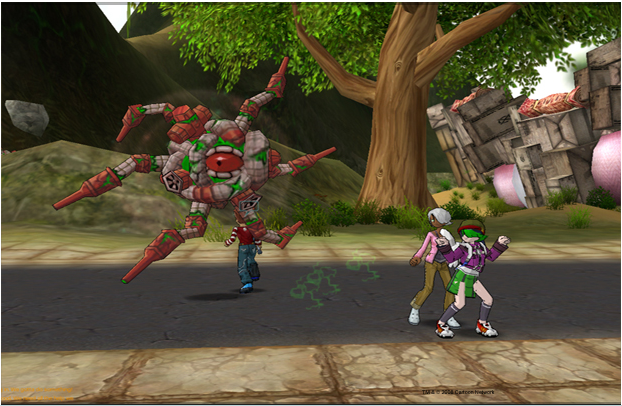
Fusion Fall takes advantage of many new features in Unity3D for creating large worlds. I live blogged some of the details as Joachim presented them at the Unite Conference.
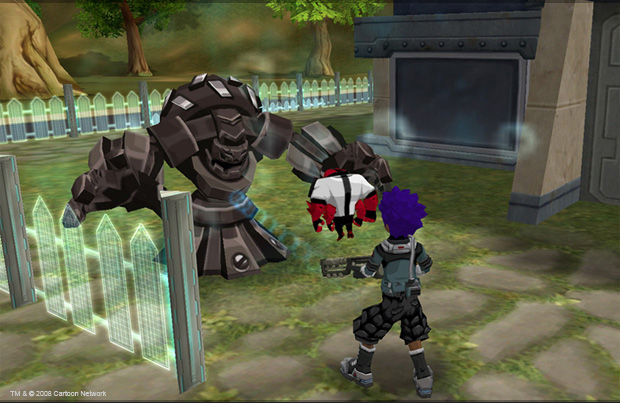
Unity uses the Mono runtime on both Windows and MacOS and it might become one of the largest deployment vehicles for the Mono VM.
There is an air of coolness in the fact that Mono is being used on Windows instead of .NET. And part of it has to do with the fact that Mono's open source engine allowed Unity to modify it to suit their very specific needs.
As I mentioned at my PDC talk, the .NET engine is fantastic, but up until Mono only Microsoft was in a position to reshape .NET into different forms (Silverlight and Mesh both use a special trimmed-down .NET called CoreCLR). I would love to see a world where people take Mono (or chunks of Mono) tune it and shape it to suit their needs.
Congratulations to the team at Unity for a job well done, and to the team that produced FusionFall. You can see the introduction video:
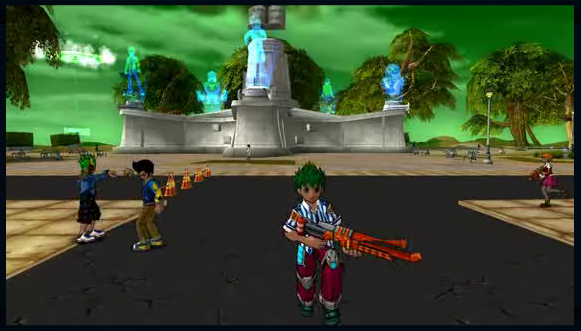
One thing that stands out in FusionFall is that it shows what a big creative budget can do with Unity.
Go Mono gaming, Go!
Posted on 22 Jan 2009
Linux and the Inauguration
Not only was the inauguration transmitted using Silverlight, but also on each window for everyone watching the inauguration from pic2009.org the following caption was at the bottom of every page:
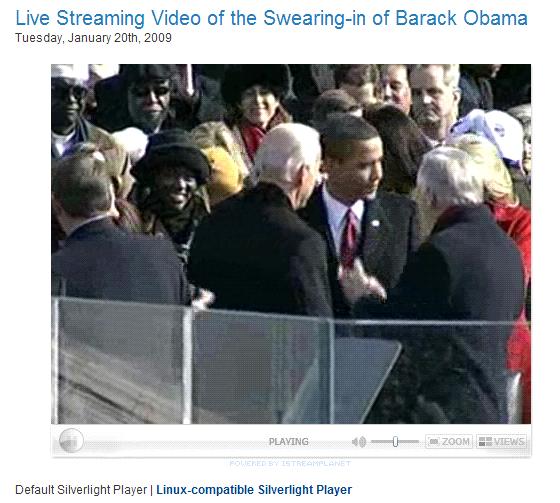
Every viewer could see "Linux-compatible Silverlight Player".
Posted on 21 Jan 2009
Watching the Obama Official Inauguration on Linux with Moonlight.
 I just wanted to confirm that you can watch
today's
Barack Obama
Official Inauguration video stream using Moonlight on
Linux/x86 and Linux/x86-64 systems.
I just wanted to confirm that you can watch
today's
Barack Obama
Official Inauguration video stream using Moonlight on
Linux/x86 and Linux/x86-64 systems.
All you need to do is to go to the Moonlight Download page, install Moonlight and restart your browser. Then you can visit www.pic2009.org in a few hours and watch the event from Linux.
Microsoft worked late last night to get us access to the code that will be used during the inauguration so we could test it with Moonlight.
Thanks to: Joseph, Larry, Geoff, Rusty and specially Aaron who all worked tirelessly to implement and get everything tested tonight and ready to go on the Novell side. To Brian, Eric, Ben at Microsoft and Mio at IStreamPlanet to make sure that Linux users will be able to watch Obama's inauguration.
Ben Waggoner has posted an update on the Microsoft side..
Aaron's code will also be powering MacOS/PPC streaming.
Now everyone say at once: O-ba-ma! O-ba-ma! O-ba-ma!
Posted on 20 Jan 2009
Mono's New Code Generation Engine
Three years ago, in November of 2005 we started a project to upgrade Mono's code generation engine as the engine started to age and it became increasingly difficult to improve code generation and extend the JIT engine in meaningful ways.
The new code generation engine is based on a linear intermediate representation as opposed to the tree-based intermediate representation that we had used up to Mono 2.0.
Switching the code generation engine is a pretty significant effort and we did not want to switch it shortly before we had to ship Mono 2.0, so we decided to ship 2.0 with the engine that had been in wide use.
Shortly after we branched Mono's tree for the 2.0 release Zoltan merged his work from the linear branch into the main tree.
We have now shipped all of this as part of Mono 2.2, you can get it here.
Some Benchmarks
Mono's new engine generates much better code than the version found in Mono 2.0.
Speed: The engine will mostly benefit computationally intensive code, usually between 10% and 30% performance increase, with some cases going up as high as being 50% faster.
Code size: the new engine generates slimmer code, typically 12% to 20% smaller code generated.
Check out some of the benchmark results.
Debugging the Transition
Although we had our test suite, and we regularly tested the code against most apps, we were still afraid that something might go wrong. The new code could miss-compile something, and it would be hard in a large project to pin point exactly what went wrong.
For example, the problem might not appear while compiling a small test program like `hello world', but could appear when running a web site under heavy load or when running MonoDevelop.
Zoltan came up with a very interesting solution: for a period of time Mono had two JIT engines built into it, the new and the old one. Here is where the clever trick comes in: an environment variable contained the number of methods that should be compiled with the new JIT engine. After the Nth method had been compiled, the engine would switch code generators.
This was used to bisect regressions and failures.
A couple of months after we had done the switch and both our unit tests and our system tests passed the old JIT engine was eliminated from Mono.
SIMD
Using SIMD for accelerating certain floating point operations had been in the back of our minds for a while. We looked into implementing that in our old engine, but that turned out to be very difficult.
With the new engine, Rodrigo was able to put together a prototype in a weekend (the legend goes that Rodrigo's wife was busy that weekend).
This prototype was later turned into Mono.SIMD an API for accelerating vector operations.
Mono 2.2 is the first release to officially support and distribute it. To learn more about Mono.SIMD support, you can see this blog entry.
Full Generics Sharing
With this release, the generics code sharing engine has been completely debugged and is now enabled not only for code that lives in mscorlib, but for all generics code written by the user.
The Technical Details
We have provided A complete description of Mono's new engine design and the the various code generation stages.
Posted on 20 Jan 2009
More Mono-based games on the iPhone
Update: as of September there are at least 258 games on the AppStore build with Unity3D according to this interview. And 5 out of the Top100 applications are Unity based.
Randy Edmonds pointed out in my previous post that FlashBang Studios's RaptorCopter is not the first or the only Unity3D/Mono-based game on the Apple AppStore.
I counted almost 40 apps on the AppStore based on Mono, from the thread here.
These are a few other games available today from the AppStore that are powered by Mono:
- Downhill Bowling (5 stars), (screenshots and video).
- Billiards.
- SpacePig.
- Age of Curling.
- Dusktreaders.
- X-Razer.
- Tapball (video).
- InvinciBall (video).
- SlidePop.
- FuguMaze.
- Monkey Diving (video).
- Ball-X (with the dash in the middle, or you wont find it).
- FuguTilt.
- Pizza Dash (you deliver pizzas in a car).
- Debris (you do controlled demolitions).
- Trash it!
- Rotunda.
- Asteroid Strike.
- Crazy Snowboard (and 2.0).
- Bubble Bang (video).
- iStronaut Willy.
- Bounce Pop.
- Labyrinth 3D.
- FuguBall.
- SpaceRace (video).
- iDrone.
- Mars Explorer.
Word games:
- Christmas spell.
- Alpha Blocks: Brain Freeze.
Not really games, but cool hacks:
- Moobox 3D, cute!
- Widget Monkey.
- Butterflies.
- Dice 3D.
- Night Divine.
- Rainbow Day.
- Zen of Snow and Zen of Snow 2.
- Jingle Bells.
- ArtiFISHal Life (3D Aquarium).
- Leaves.
- iFeathers.
- Bobblehead Santa.
Update:
- Cricket (from SpinFast).
- Rock'em Blocks (video).
- Pelagic Tones.
Posted on 07 Jan 2009
First Mono-based Wii Game on the Shelves
 Christian Lassmann from Weltenbauer Software
Entwicklung GmbH, who I had the pleasure of meeting at the
Unite Conference in Denmark in October, just wrote to tell me
that "My Animal
Center", a game built
with Unity3D's
Wii Edition and Mono hit the shelves on December 20th in
Germany.
Christian Lassmann from Weltenbauer Software
Entwicklung GmbH, who I had the pleasure of meeting at the
Unite Conference in Denmark in October, just wrote to tell me
that "My Animal
Center", a game built
with Unity3D's
Wii Edition and Mono hit the shelves on December 20th in
Germany.
The game uses C# extensively. It was a joy to hear Christian explain how the various effects were created, I wish he blogged about it.
Cute trailer (text is in German):
The game is coming to a Wii near you in the US soon.
Posted on 06 Jan 2009
First Mono-game hits the Apple AppStore
Blurst's Raptor Copter game built using Unity3D and Mono just hit the Apple AppStore.
From the announcement:
Raptor Copter has become our first Unity-made iPhone game to hit the App Store! We’re making it available for a limited-time price of $0.99. The game is a loose follow-up to Off-Road Velociraptor Safari. Instead of a jeep, you have a Chinook helicopter, but the basic game loop is the same: Capture raptors, drop them into factories, and teleport their sweet meats to the future.You can get it for your iPod Touch or iPhone from this Raptor Copter iTunes Link.
Cute video:
Unity3D is using Mono's full static compilation to allow the game to run JIT-less and interpreter-less on the iPhone.
Posted on 06 Jan 2009
Mono goes Accessible!
Brad Taylor has announced the first release of the Mono Accessibility stack:
UI Automation provides programmatic access to most user interface (UI) elements on the desktop, enabling assistive technology products such as screen readers to provide information about the UI to end users and to manipulate the UI by means other than standard input. UI Automation also allows automated test scripts to interact with the UI.
Mono's Accessibility Framework is an implementation of UI Automation. The same API that is available for WPF and the framework is used by Silverlight and Windows.Forms.
Client Code: The initial launch of Mono Accessibility adds accessibility support to applications built with Windows.Forms to be accessible.
Backend Code: The code has a bridge that talks to the existing ATK framework on Linux.
In the future the Mono Accessibility framework will be used in our own Moonlight 2.0.
Check the release notes, install from source or use OpenSUSE's 1-click install.
Posted on 05 Jan 2009
Mono Goes to Android
Koushik Dutta got Mono running on the Android-based G1 phone.
He posted a video of the phone compiling "Hello World" (he points out that it is slower due to Mono running from the SD card):
He also posted some performance and memory usage comparisons between Dalvik, Mono and Java/ARM. Short story: Mono does great!
There are some caveats on running Mono on the G1, see the comments on this post. Still, these are encouraging news.
Posted on 05 Jan 2009
Blog Search
Archive
- 2024
Apr Jun - 2020
Mar Aug Sep - 2018
Jan Feb Apr May Dec - 2016
Jan Feb Jul Sep - 2014
Jan Apr May Jul Aug Sep Oct Nov Dec - 2012
Feb Mar Apr Aug Sep Oct Nov - 2010
Jan Feb Mar Apr May Jun Jul Aug Sep Oct Nov Dec - 2008
Jan Feb Mar Apr May Jun Jul Aug Sep Oct Nov Dec - 2006
Jan Feb Mar Apr May Jun Jul Aug Sep Oct Nov Dec - 2004
Jan Feb Mar Apr May Jun Jul Aug Sep Oct Nov Dec - 2002
Jan Feb Mar Apr May Jun Jul Aug Sep Oct Dec
- 2022
Apr - 2019
Mar Apr - 2017
Jan Nov Dec - 2015
Jan Jul Aug Sep Oct Dec - 2013
Feb Mar Apr Jun Aug Oct - 2011
Jan Feb Mar Apr May Jun Jul Aug Sep Oct Nov Dec - 2009
Jan Feb Mar Apr May Jun Jul Aug Sep Oct Nov Dec - 2007
Jan Feb Mar Apr May Jun Jul Aug Sep Oct Nov Dec - 2005
Jan Feb Mar Apr May Jun Jul Aug Sep Oct Nov Dec - 2003
Jan Feb Mar Apr Jun Jul Aug Sep Oct Nov Dec - 2001
Apr May Jun Jul Aug Sep Oct Nov Dec