Feedback wanted: StackOverflow DevDays in Boston
 I will be presenting
at StackOverflow
DevDays in Boston, on October 7th at 4.20pm.
I will be presenting
at StackOverflow
DevDays in Boston, on October 7th at 4.20pm.
As usual, I will be talking about Mono. But since Mono is an giant universe, I would like to know what the audience would like to hear about.
Please fill in my small survey to provide feedback.
See you there!
Posted on 30 Sep 2009
Pictures: ECMA 334/335 January 2003
At the ECMA meeting in January of 2003 Anders was presenting C# 2.0:
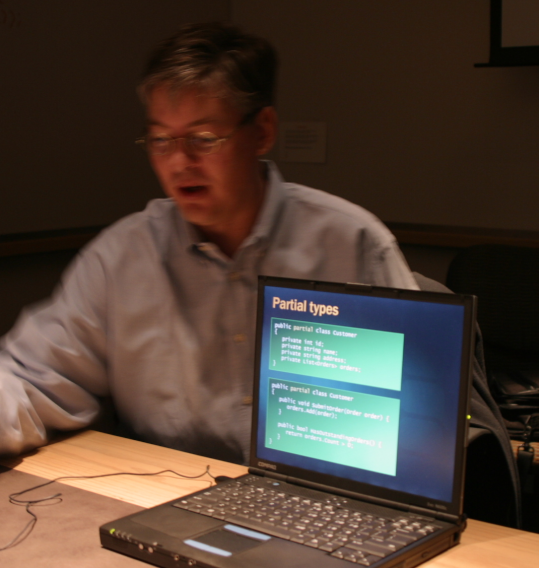
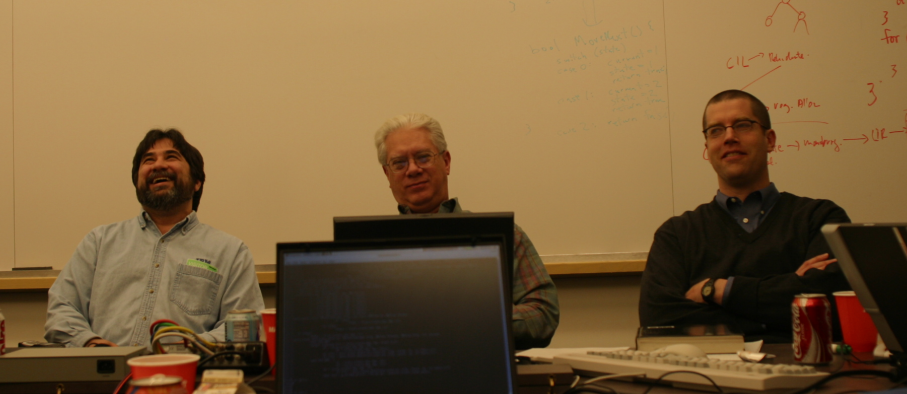
Todd Proebsting had just developed iterators for C# and was presenting, it was inspired by his previous work on Icon's iterators. Sam Ruby (from IBM), Thomas Plum (from Plum Hall) and Todd:
Anonymous methods, the foundation for lambdas in C#, used a beautiful code generation technique. Anders who has a beautiful hand writing was explaining the design to the committee:

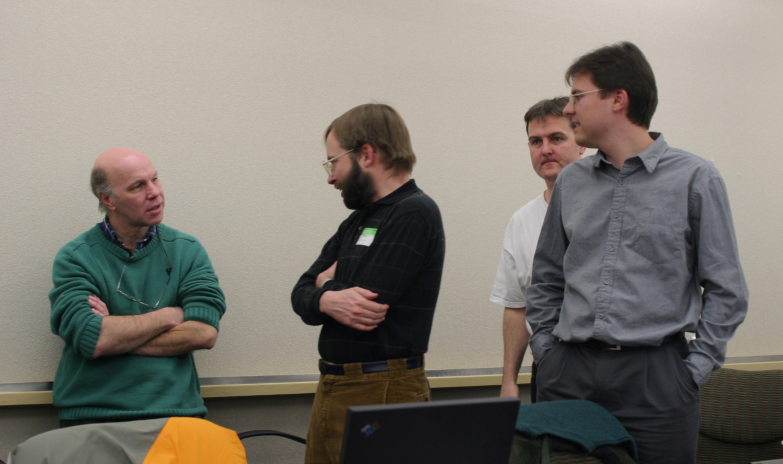
Jim Hogg presented the design for generics in the ECMA CIL. Here he is discussing with Arch (at the time with Intel, and the guy behind ECMA's System.Parallelization), Jon Jagger and Emmanuel Stapf (ISE Eiffel):
Joel Marcey, then at Intel and Jim Miller:
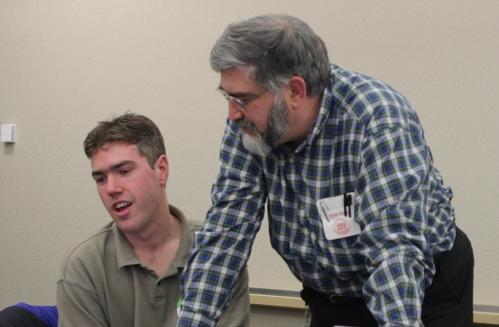
Todd and Chris Fraser. I was fanboying them. Mono's original JIT design was based on a lot of his work. At dinner Chris recommened Csikszentmihalyi's book on Flow, which I loved:

Posted on 26 Sep 2009
Comment Policy on my Blog
Here is a rough draft of the comment policy for my blog.
When you come to my blog to comment, you are a guest in my blog and your opinions are hosted there in the same way that you would be hosted if you showed up at my place to chat.
So standard rules of social engagement are required. If you are unable to operate under regular social situations and you feel the need to insult others or myself in my blog, not only you are not welcome, but your comment will not show up and will be promptly deleted.
Constructive criticism is always welcome on my blog, now
If you feel the need to be rude, offensive, lie or you are intentionaly trying to start a fight, I encourage to do that in your blog.
If you can not articulate your thoughts without attacking and you can not keep your temper in check, I encourage to do that on your own blog.
Trolling will be removed.
Posted on 25 Sep 2009
Branching for Mono 2.6
Today Andrew branched Mono trunk for the Mono 2.6 release.
Mono 2.6 is the last release that will support the mscorlib 1.1 profile and the C# 1.0 compiler. We are now moving to a pure generics world with Mono.
Update: Specifically, we will be removing the 1.0 assemblies from the build, the mcs.exe command will now point to gmcs.exe, all of the xxx1 command versions will be eliminated and all of the conditional code in the Mono class libraires that depended on NET_1_0 and NET_1_1 will be removed.
As for the Mono 2.6 release notes: we will put those together in the next few days. Please be patient.
Posted on 25 Sep 2009
On Richard Stallman
I want to say that God loves all creatures. From the formidable elephant to the tiniest ant. And that includes Richard Stallman.
As for me, I think that there is a world of possibility, and if Richard wants to discuss how we can improve the pool of open source/free software in the world he has my email address.
Love, Miguel.
Posted on 23 Sep 2009
MonoTouch 1.0 goes live.
 MonoTouch is a
commercial product based on Mono and is made up of the
following components:
MonoTouch is a
commercial product based on Mono and is made up of the
following components:
- MonoTouch.dll The C# binding to the iPhone native APIs (the foundation classes, Quartz, CoreAnimation, CoreLocation, MapKit, Addressbook, AudioToolbox, AVFoundation, StoreKit and OpenGL/OpenAL).
- Command Line SDK to compile C# code and other CIL language code to run on the iPhone simulator or an iPhone/iPod Touch device.
- Commercial license of Mono's runtime (to allow static linking of Mono's runtime engine with your code).
- MonoDevelop Add-in that streamlines the iPhone development and integrates with Interface Builder to create GUI applications.
The MonoTouch API is documented on the Mono site. The MonoTouch API is a combination of the core of .NET 3.5 and the iPhone APIs.
We have created some tutorials on how to use MonoTouch and you can read the design documentation on the MonoTouch framework.
Some History
Almost a year ago when we released Mono 2.0 for OSX, I asked the readers of this blog to fill a survey to help us understand where we should take Mono.
Many developers asked us to provide Mono for the iPhone.
A year ago, it was possible to use
Mono's static
compiler to compile ECMA 1.0 CIL bytecode for the iPhone.
This is the technology that powered Unity3D's engine for the
iPhone.
Users of
Unity3D have
published more than 200 applications on the AppStore.
We debated internally what exactly Mono for the iPhone
would be. We considered doing a Windows.Forms port, to bring
Compact Framework apps to the iPhone, but that would have
required a complete new backend for Windows.Forms and would
have required also a "theme" engine to make it look like the
iPhone. We discarded this idea early on.
We decided instead to go with a native binding the iPhone
APIs. It would not be a cross platform API and it would tie
developers to the iPhone platform, but it would also mean that
applications would look and feel native, and developers would
get closer to the iPhone.
Creating a binding for the Objective-C APIs with .NET in
the past has relied extensively on dynamic code generation,
and this
feature is not available on the iPhone (the kernel
prevents JIT compilation from taking place). As we started
doing the work to bind the low-level C APIs, Geoff started
prototyping a new Objective-C/C# bridge that was specifically
designed to work within the iPhone requirements.
By the time we had sorted out the foundation and the
Objective-C bridge we had gained some fresh experience from
binding the C++ PhyreEngine to .NET and we decided to create a
new binding generator to simplify our life (I will blog about
this new approach to binding creation in another post).
At this point, we started investing into supporting not
only the device, but support the simulator. This would prove
to be incredibly useful for quickly testing the code, without
having to wait a long time to compile and deploy on the
device.
At this point, we had enough to create mix-mode GUI
applications (they were mostly Objective-C apps hosting Mono)
and the pipeline was horrible: it involved using some 3
compilers, having 3 Mono checkouts and applying individual
patches to all trees.
We were aware of how easy Unity had made things for their
users, they had set the bar pretty high in terms of usability
for us. Unity had some advantages, they could "debug"
without deploying the code to the device, something that we
could not really do ourselves.
We were still far from this.
We introduced a command that would isolate all of the
complexities of creating simulator and ARM executables, the
mtouch command.
With the mtouch command and the bindings complete, we
started trying out the API
by porting
the Apple iPhone samples from Objective-C to C#. And in
the process finding two things: C# 3.0 constructor
initializers are a thing of beauty:
And also that the samples ported were half the size of the
equivalent Objective-C programs.
As we were doing this work to iron out the kinks in the API
design, Michael got started on designing the MonoDevelop
support for the iPhone. This included the regular bits that
you would expect like templates, building, running and
deploying, but most importantly the Interface Builder
integration.
Interface Builder produces an XML file that describes your
UI, and it is able to generate some header files for you, but
in general developers that want to refer to components in the
UI and implement their backing store have to repeat the same
stuff over and over. For example, controlling the contents
of a label on the screen requires the developer to declare the
same variable three times: 2 in the header file, and one in
the Objective-C file (if you are lucky).
We took a different approach. We made it so that
MonoDevelop would automatically generate a code-behind partial
C# class for each Interface Builder file. This meant that
to users the entire process would be transparent.
They would define outlets or messages, and those would just
become part of their class. Intellisense and code completion
would become available to them without any extra coding.
The Developer Experience
UIControl SliderControl ()
{
	var slider = new UISlider (new RectangleF (174f, 12f, 120f, 7f)){
		BackgroundColor = UIColor.Clear,
		MinValue = 0f,
		MaxValue = 100f,
		Continuous = true,
		Value = 50f,
		Tag = kViewTag
	};
	slider.ValueChanged += delegate {
		Console.WriteLine ("New value {0}", slider.Value);
	};
	return slider;
}
Posted on 14 Sep 2009
CodePlex Foundation
 Microsoft today launched
the CodePlex Foundation a
non-profit organization to promote the open source
collaboration between companies and open source communties,
projects and individuals.
Microsoft today launched
the CodePlex Foundation a
non-profit organization to promote the open source
collaboration between companies and open source communties,
projects and individuals.
This is another step in the right direction for Microsoft. I have been working on open source software since 1992, and back then a world where open source played a major role was a dream to many of us. Microsoft adopting open source licenses, releasing some of their code under open source licenses and being a better community member was the stuff of fiction.
There are still many things that I would like to see Microsoft do, and many things that I believe Microsoft has to change to become a full member of the open source community, but it is encouraging to me to see Microsoft evolve. I hope that the CodePlex foundation will help us continue to build bridges between our communities.
I am glad that I was asked to be part of the board of directors of the foundation. And to work together with some great advisory board.
I hope that I can last more on this foundation than I lasted at the FSF, where I was removed by RMS after refusing to be an active part of the campaign to rename Linux as GNU/Linux.
Posted on 10 Sep 2009
MonoDevelop 2.2 Beta 1: We go cross platform.
 MonoDevelop goes cross platform.
Since the beginning of time, man has yearned to get a cross platform .NET IDE. Homer's Odyssey described one man's effort to achieve such a thing. And it was not until today, September 9th of 2009 that the world can test out such a tool.
With this release MonoDevelop leaves its cozy Linux nest and embarks on a wild adventure into the hearth of MacOS and Windows. The MonoDevelop team made this one of their major goals for this release: to turn our loved IDE into a cross platform IDE.
If you are curious about the details, check out the What is new in MonoDevelop 2.2 page.

MonoDevelop on Windows
We are not only bringing MonoDevelop to OSX and Windows as a plain GUI port, but we are also providing installers, deep operating system integration and support for native debugging on each platform.

MonoDevelop on MacOS X
In addition to becoming a cross platform IDE, there are many new features in MonoDevelop.
For instance, MonoDevelop can be used to develop ASP.NET MVC applications on OSX and Linux and Silverlight applications on OSX and Linux.
Debugger
MonoDevelop now has integrated debugger support. Not only it is able to debug Mono applications, it also can work as a frontend to GDB to debug native applications.
In addition, on Linux it is possible to debug ASP.NET pages.
New Add-ins
New exciting add-ins: ASP.NET MVC, Silverlight and iPhone (for use with MonoTouch).
Policies
A common problem that we face as open source developers is that not every project uses the same coding style. Different teams use different coding conventions. MonoDevelop now supports policies to describe how files should be edited and what defaults should be used in each:

Editor Improvements
My favorite new feature is Dynamic Abbrev (Alt-/) a feature that we brought from Emacs and that fills me with joy. That being said, for the non-Emacs lovers there are plenty of features that you asked for, and that we implemented:
- Extensive refactoring support. And I mean, it is extensive.
- Code templates.
- On the fly formatting.
- Acronym Matching in Code Completion
- XML Documentation Shown in Code Completion
- VI mode for those users hooked up on VI commands, they can now use those within MonoDevelop.
Another pretty cool feature is the code generation support that is triggered with Alt-Insert. When you press Alt-insert it will popup a context sensitive dialog box that offers a few options of code that could be generated at this point: ToString methods, Equals/GetHashCode methods all based on existing fields and properties.
Why go Cross Platform?
Going cross platform means that developers will have the same tool across all of the operating systems they use: Windows, Mac and Linux.
.NET developers that have been enchanted by OSX will be able to continue developing software with their favorite programming languages while enjoying OSX and will be able to go back and forth between Windows, OSX and Linux as needed. This also means that they can work with developers in other platforms, regardless of the personal choices of other team members.
As many of you know, the number of contributors to a project is linked to the number of users of that project. By expanding our market presence from Linux, we expect to get contributions, fixes, improvements, bug reports, code and add-ins from developers in other platforms.
We intend to make MonoDevelop the Eclipse of the .NET community. Just like Eclipse became the foundation for Java development, we hope that MonoDevelop will become the foundation for .NET development, and hopefully for much more than that.
A multi-system IDE
We are not religious when it comes to supporting other programming languages [1]. We want to embrace not only .NET-based projects like Gtk#, Silverlight, ASP.NET, Boo, C#, F#, Visual Basic and Windows.Forms. We are also embracing other developer platforms like Python, C/C++, Vala, and we want to expand our presence to work with the Flash, PHP, Ruby, Rails, Flex and any other communities that need a cross platform IDE.
[1] we are just religious about the fact that C# is a better programming language to build an IDE than Java is.
Thanks!
This release could not have been possible without the endless nights and the collaborations of our contributors and all of the end users that reported bugs and gave us feedback.
Posted on 09 Sep 2009
Mono Survey Time!
Is it that time of the year when I unleash Google Docs' Survey platform on the users of my blog.
Every once in a while people ask us "When will you support Mono on..." and our answer is usually "thanks for your feedback, we will carefully consider it".
The reality is that all we have at this point is a lot of anecdotal data. Since my previous surveys on Mono, Mono for OSX, Mono for the iPhone and Mono for Visual Studio turned out to be great tools to understand what people actually want, I have created a new survey.
In this survey, I want to know how much people are willing to pay for (or not pay) for Mono commercial support on a variety of platforms: Red Hat Enterprise Linux, HP-UX, AIX, Solaris on a variety of architectures.
Go to my survey
Posted on 08 Sep 2009
Mono/.NET CodeCamp in Catalonia, Spain
The .NET and Mono user communities are working together in Spain to organize a joint .NET/Mono Code Camp. This Code Camp is going to be interesting because it is putting together two communities with very different points of view, but between which there is a lot of synergy. It will be a good chance to talk about Mono, Moonlight, MonoDevelop, MonoTouch and all the stuff we are working on.
Lluis just announced that the call for papers is ending this Friday, so not much time is left if you want to participate with a talk. There are more details in his blog post
Posted on 08 Sep 2009
MonoTouch Resources
While I was gone, a pretty nice site called MonoTouch.infowas created that is aggregating all kinds of MonoTouch samples, posts, and discussions.

From the MonoTouch Bill Splitter page.
It is aggregating many of the samples being discussed in the tweetosphere and from the MonoTouch mailing list.
The samples are particularly useful as MonoTouch merges two worlds: .NET development and Objective-C programming on the iPhone/iTouch.
MonoTouch supports the Objective-C like setup where classes can respond to messages and you have to structure your code with MVC patterns. But it also supports the C# event-style programming mode, where developers can use lambda functions to hook up to interesting events.
You can also follow @monotouchinfo on twitter.
Posted on 01 Sep 2009
GitSharp making progress
Meinrad Recheis emailed me to inform me that he has forked the Gitty project (a project that was doing a line-by-line port of a Java version of GIT) and that the project is making progress on having a full C# based GIT implementation.
GitSharp source code can be downloaded from github and they are making sure that GitSharp works on both .NET and Mono.
I can not wait for a MonoDevelop UI for it!
Posted on 01 Sep 2009
Blog Search
Archive
- 2024
Apr Jun - 2020
Mar Aug Sep - 2018
Jan Feb Apr May Dec - 2016
Jan Feb Jul Sep - 2014
Jan Apr May Jul Aug Sep Oct Nov Dec - 2012
Feb Mar Apr Aug Sep Oct Nov - 2010
Jan Feb Mar Apr May Jun Jul Aug Sep Oct Nov Dec - 2008
Jan Feb Mar Apr May Jun Jul Aug Sep Oct Nov Dec - 2006
Jan Feb Mar Apr May Jun Jul Aug Sep Oct Nov Dec - 2004
Jan Feb Mar Apr May Jun Jul Aug Sep Oct Nov Dec - 2002
Jan Feb Mar Apr May Jun Jul Aug Sep Oct Dec
- 2022
Apr - 2019
Mar Apr - 2017
Jan Nov Dec - 2015
Jan Jul Aug Sep Oct Dec - 2013
Feb Mar Apr Jun Aug Oct - 2011
Jan Feb Mar Apr May Jun Jul Aug Sep Oct Nov Dec - 2009
Jan Feb Mar Apr May Jun Jul Aug Sep Oct Nov Dec - 2007
Jan Feb Mar Apr May Jun Jul Aug Sep Oct Nov Dec - 2005
Jan Feb Mar Apr May Jun Jul Aug Sep Oct Nov Dec - 2003
Jan Feb Mar Apr Jun Jul Aug Sep Oct Nov Dec - 2001
Apr May Jun Jul Aug Sep Oct Nov Dec